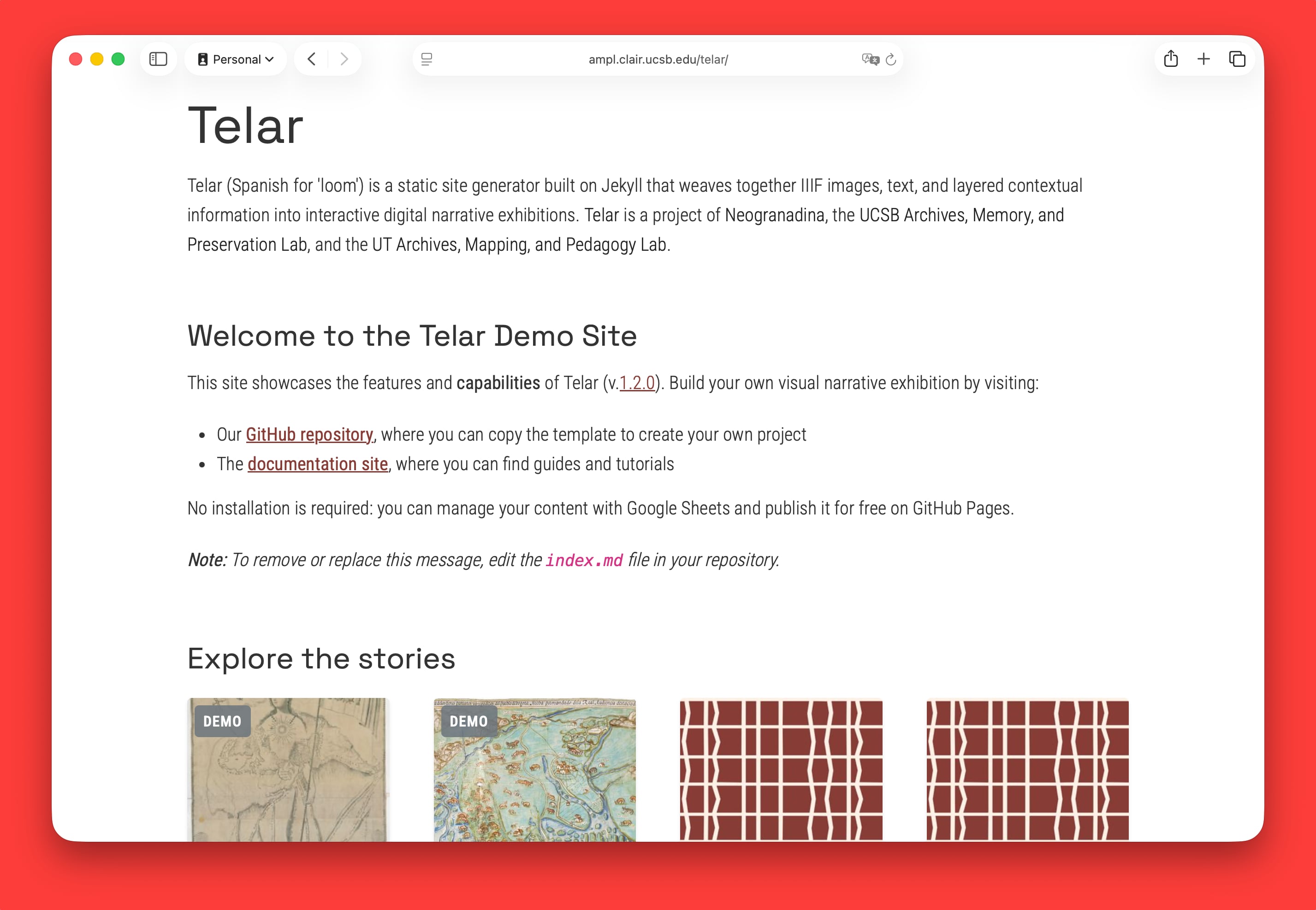
Telar — Spanish for loom — is an open-source framework for building interactive visual narratives around digitized objects, designed for scholars, students, and communities working with materials held in archives, libraries, museums, or their own collections. It is built on minimal computing principles — plain-text authoring, static site generation, free hosting on GitHub Pages — which means that a Telar project can remain online and functional for years with essentially no maintenance and no ongoing cost.
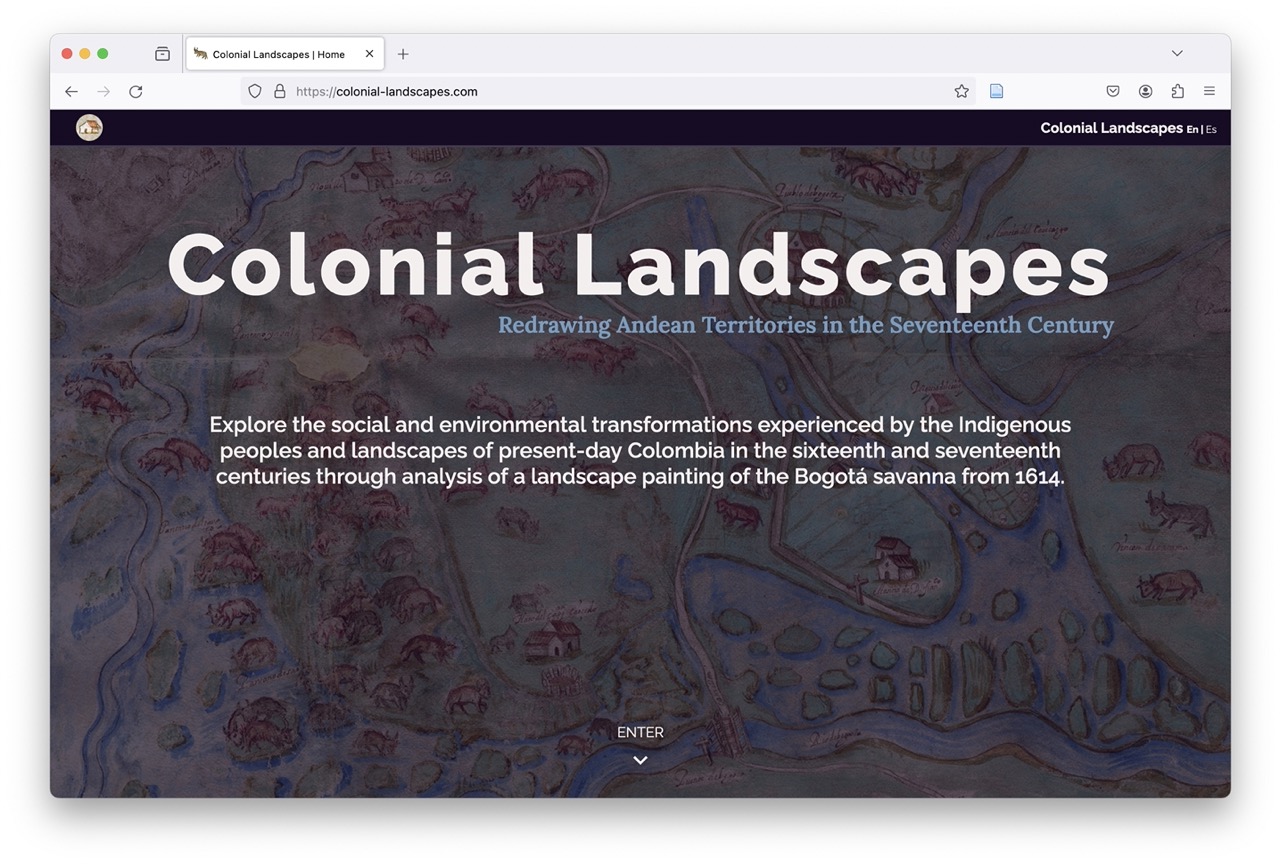
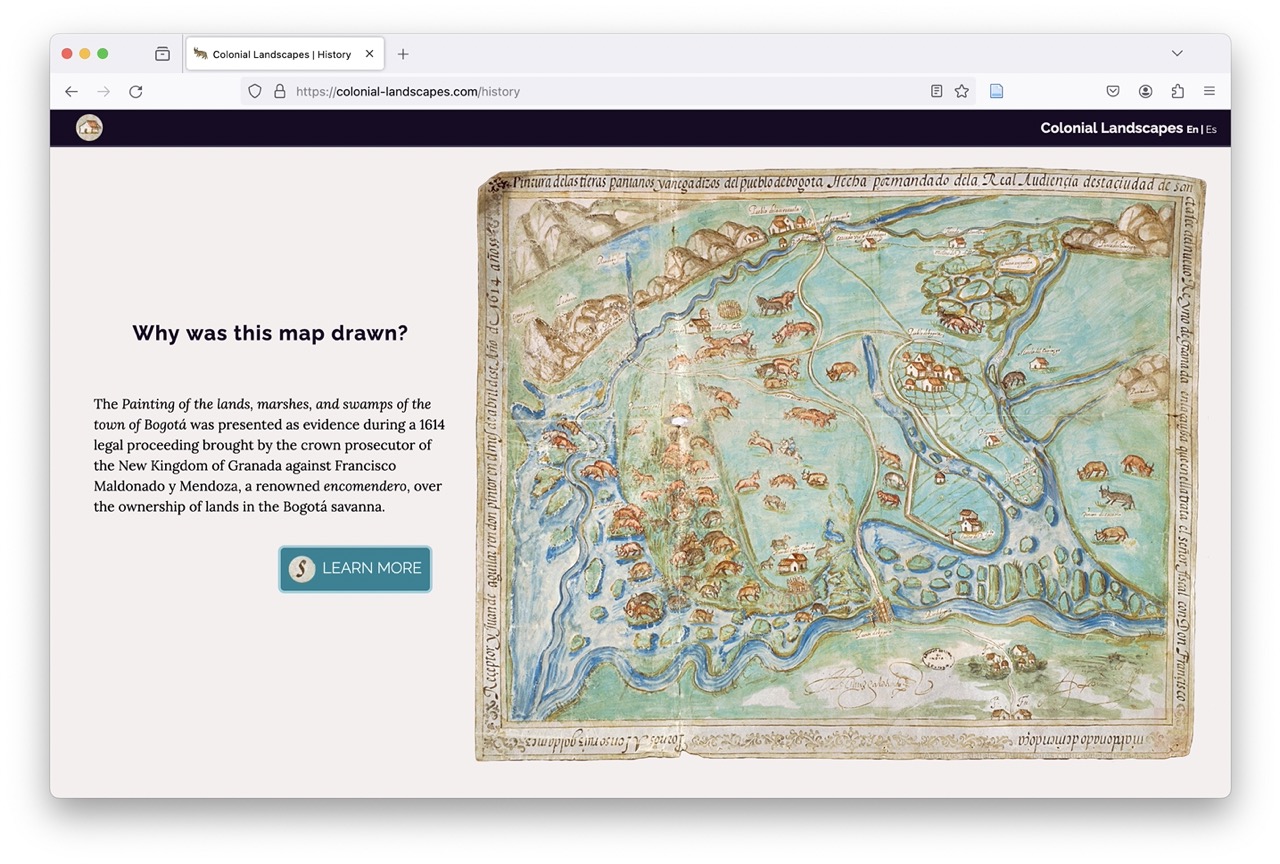
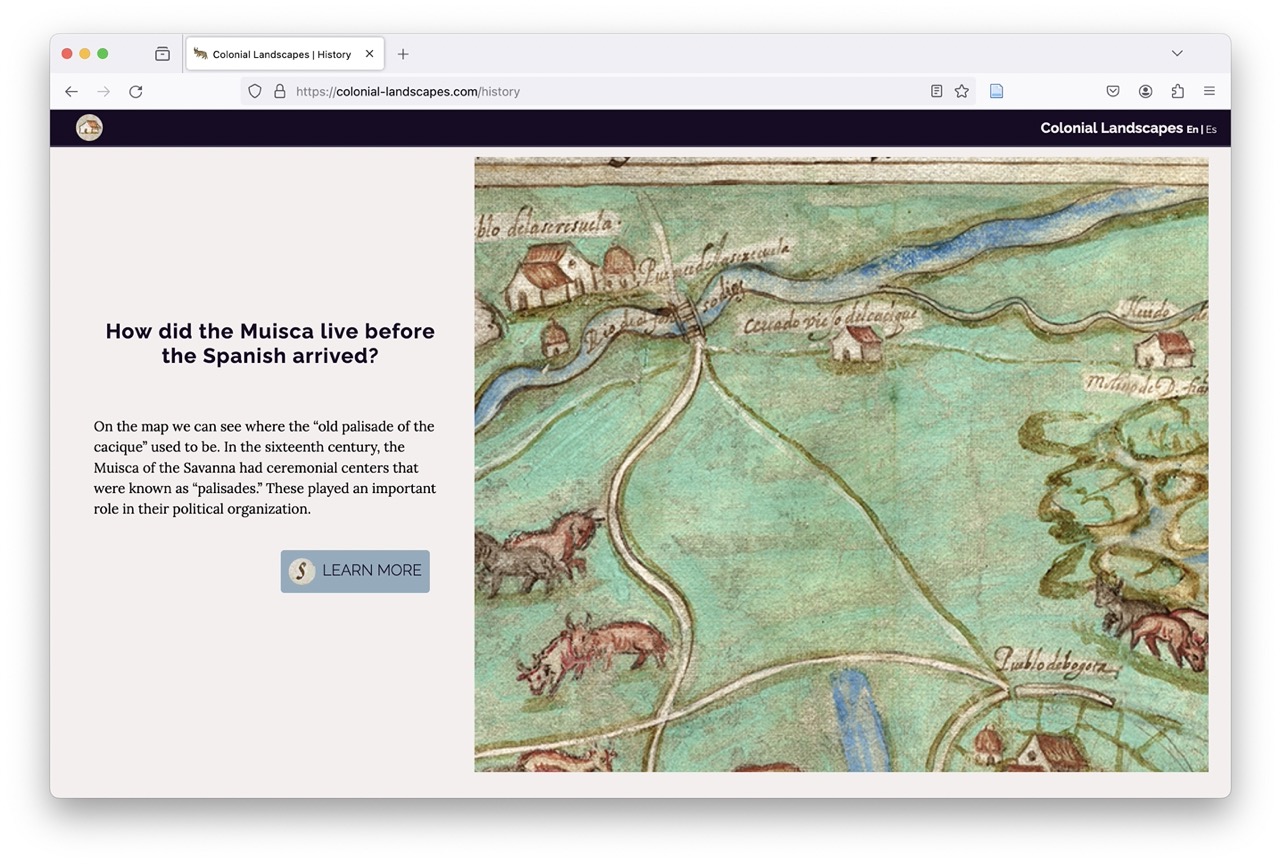
Telar grew out of Colonial Landscapes (Paisajes Coloniales), an interactive bilingual platform developed by Santiago Muñoz in 2020 that explores the history of the region around Bogotá in the highlands of what is now Colombia through a 1614 map. Intended for Colombian students in middle school, high school, and at undergraduate level, Colonial Landscapes guides readers through the map in four short chapters, drawing attention to relevant sections and using specific details as anchors for historical analysis of the changes undergone by the Indigenous Muisca peoples — and the landscape itself — as a result of European colonization. The tone is accessible and readers are invited to explore independently, while scholars can access digitized sources and relevant information for teaching and research. Designed and built by Adelaida Ávila, the platform demonstrated that it was possible to create a rich, pedagogically sophisticated visual narrative as a simple static website hosted for free on GitHub Pages. Telar generalizes that approach into a reusable open-source framework.

The core of a Telar project is a story: a sequence of steps, each pairing a specific view of an image with a brief analytical observation. Readers scroll through these steps; the image pans and zooms to follow each one. Additional layers of information — contextual panels, a glossary with auto-linking across all narratives, primary source transcriptions — are available for those who want to go deeper, without cluttering the narrative for those who do not. The authoring workflow is designed to be accessible: content is composed in Telar Compositor, AMPL’s web-based authoring environment, or directly in a spreadsheet (or Google Sheet) for users who prefer it. Users can upload their own images or use IIIF to draw from public collections — which means objects held in major research libraries can be incorporated alongside a user’s own materials.
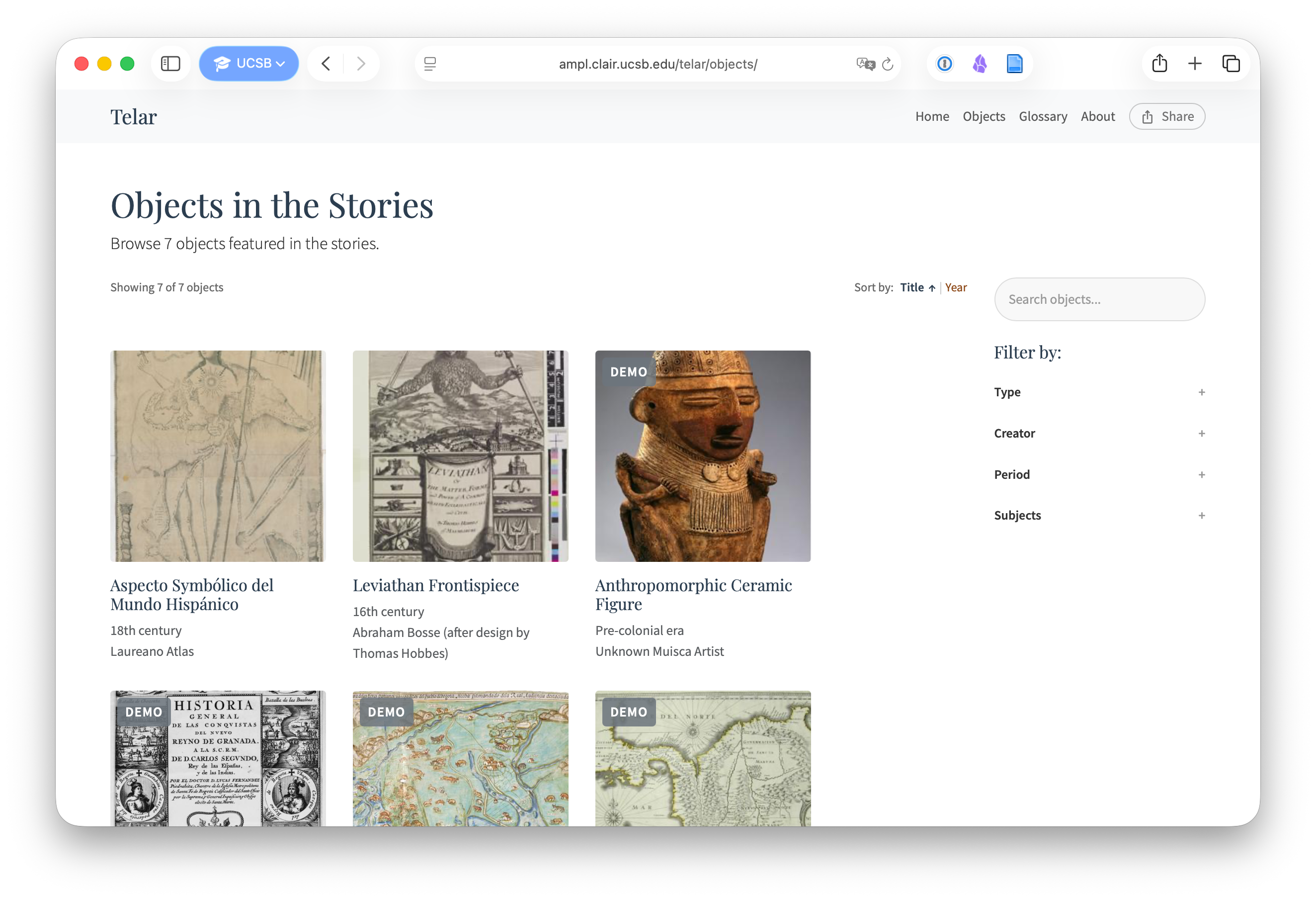
Alongside stories, Telar generates an object gallery — a searchable, filterable index of all images in a collection. Readers can browse by tag or collection, search across all object descriptions, and view any image at full resolution, independent of any narrative path. Stories and gallery draw from the same pool of objects, giving the same materials two complementary modes of engagement. This also means that Telar can work as an all-in-one digital publication system for smaller collections (Zasqua, our dedicated archival publication system, handles larger ones).
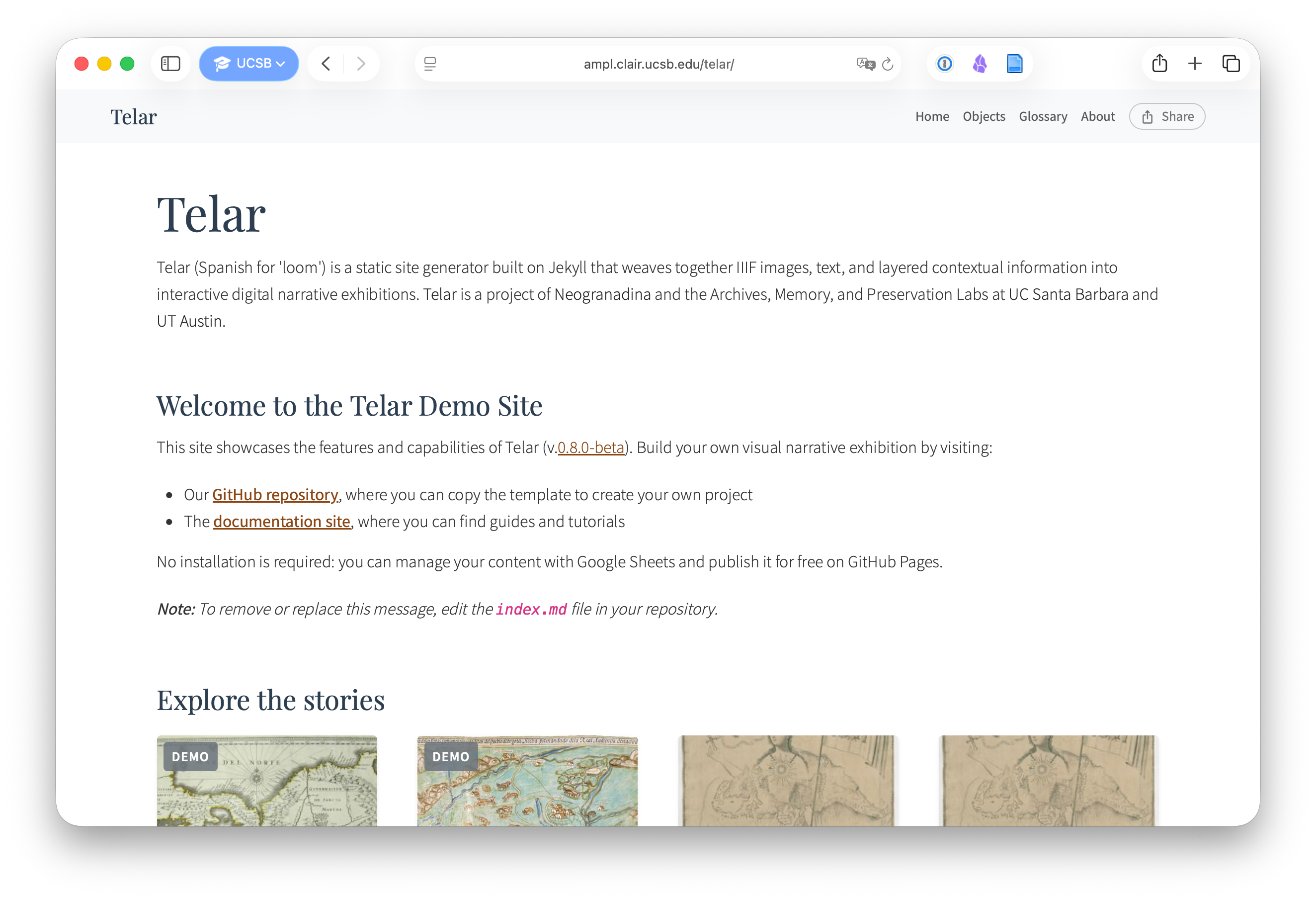
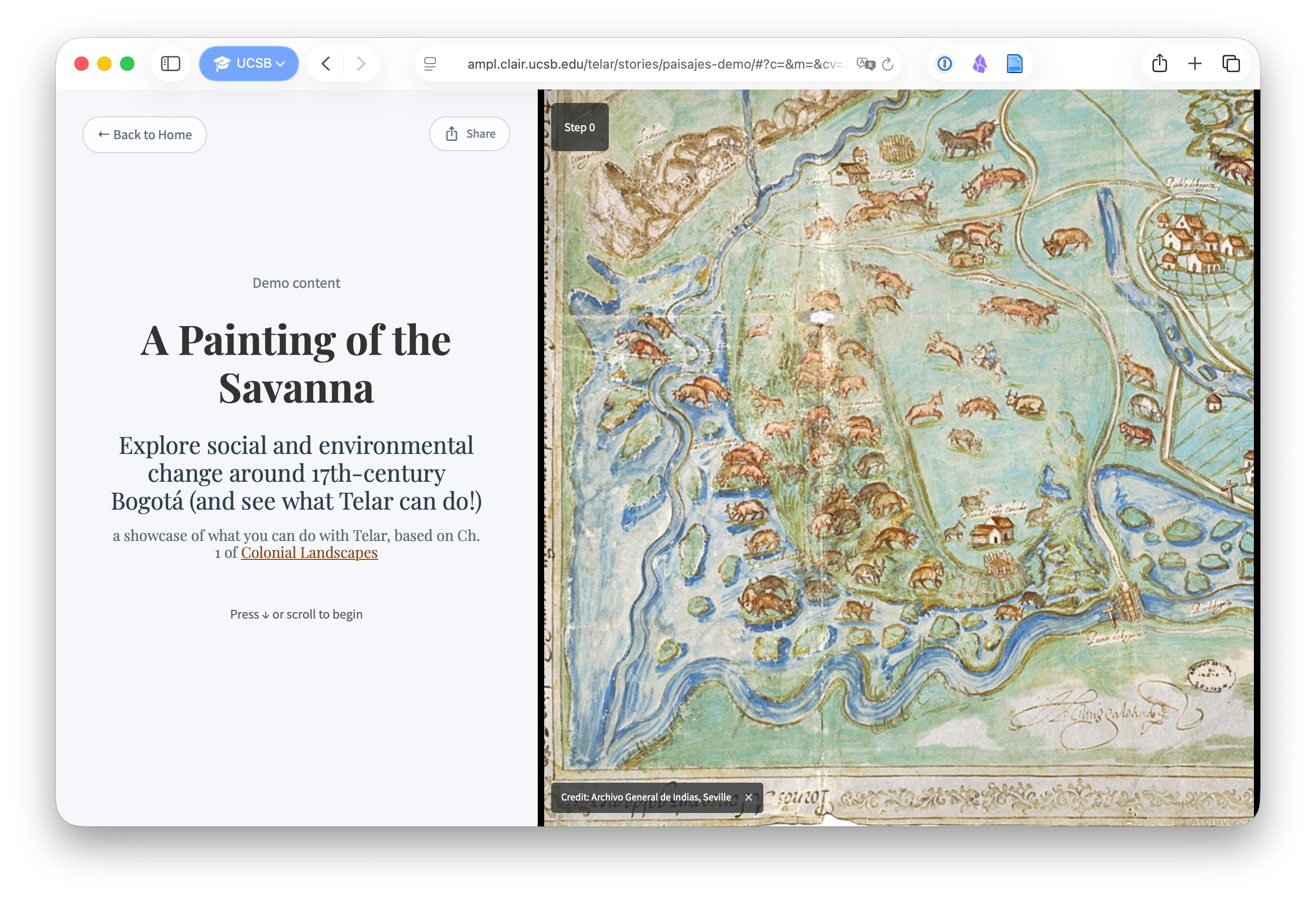
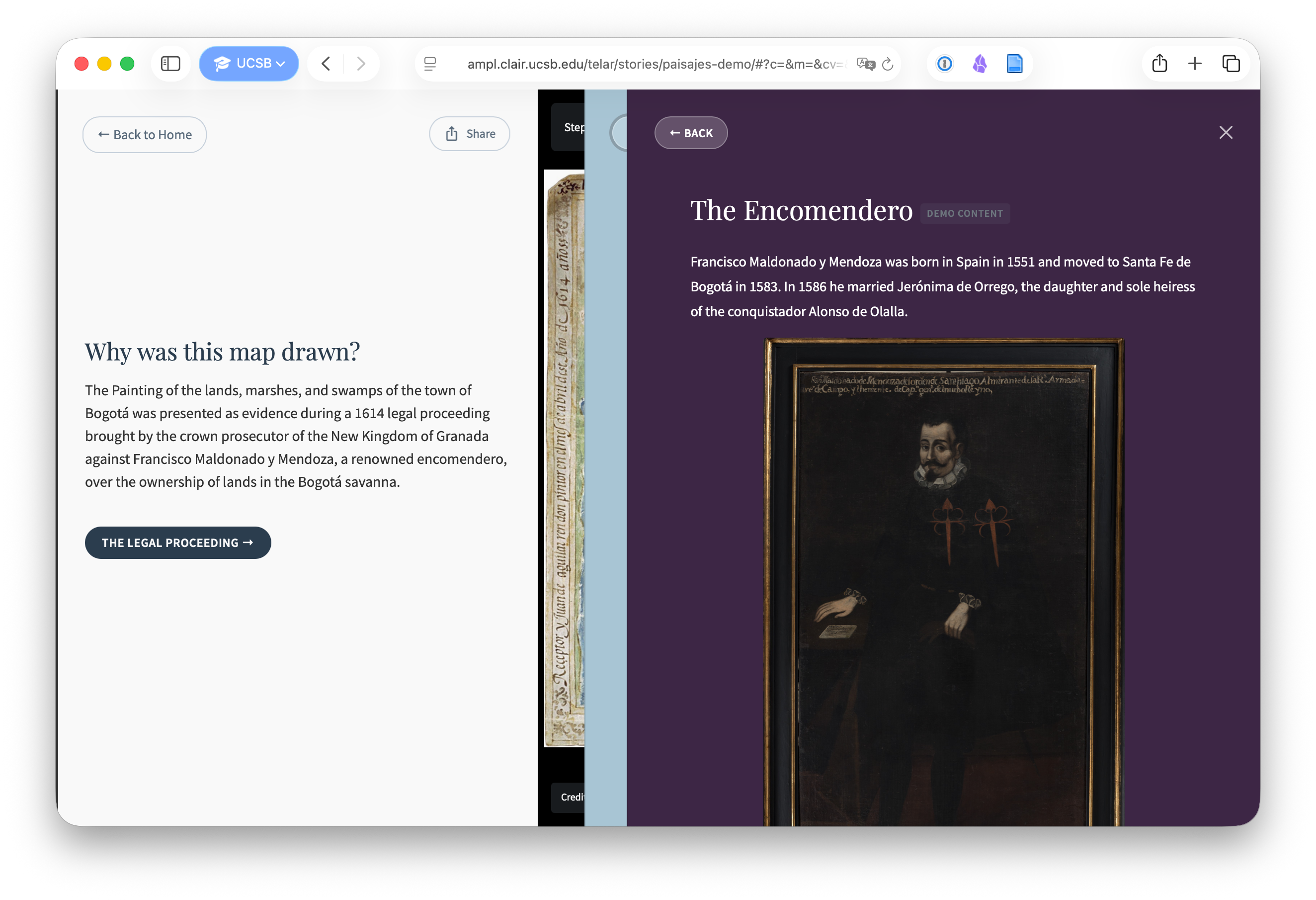
Telar was first imagined as a platform for instructors to produce layered, image-driven content, but teaching showed it was more than that. We learned its real power is not as a content delivery platform but as a composing environment — a tool for thinking. Building a visual narrative around a source requires decisions that are fundamentally about humanities thinking: what to show, what to omit, how to sequence, who the audience is. Students who use Telar produce, rather than just consume, humanities knowledge. And because authoring is in plain text and the output is a static website, they pick up transferable skills — Git, plain-text workflows, static generation — rather than locking themselves into a proprietary platform.
Telar is in active development, currently at v1.2.0 — twenty-seven releases since October 2025. It graduated from beta with v1.0.0 in March 2026. It has been used in graduate and undergraduate courses at UCSB and UT Austin, and in community-centred public history initiatives in Colombia. It supports bilingual interfaces in English and Spanish, client-side encrypted stories for sensitive or embargoed content, and embedding in Canvas LMS. Documentation is available in English and Spanish; the source code is on GitHub.
Telar is one of the four open-source primitives AMPL develops with its partners, alongside the Digitization Toolkit, which captures, Fisqua, which catalogs, and Zasqua, which publishes. Like the others, it can be used as part of a chain of tools — from digitization to storytelling — or entirely independently.
Telar is supported by the Caribbean Digital Scholarship Collective, UCSB’s Center for Innovative Teaching, Research, and Learning (CITRAL), the UCSB Library, Routes of Enslavement in the Americas (UC MRPI), and the UT Austin Department of History.