Come work at the Archives, Memory, and Preservation Lab (AMPL) of the Center for Latin American and Iberian Research!
How do you bring a four-hundred-year-old document to life for people who have never seen one? In our storytelling projects, you will build visual stories and interactive games around historical sources, using Telar, the open-source storytelling framework we develop at AMPL.
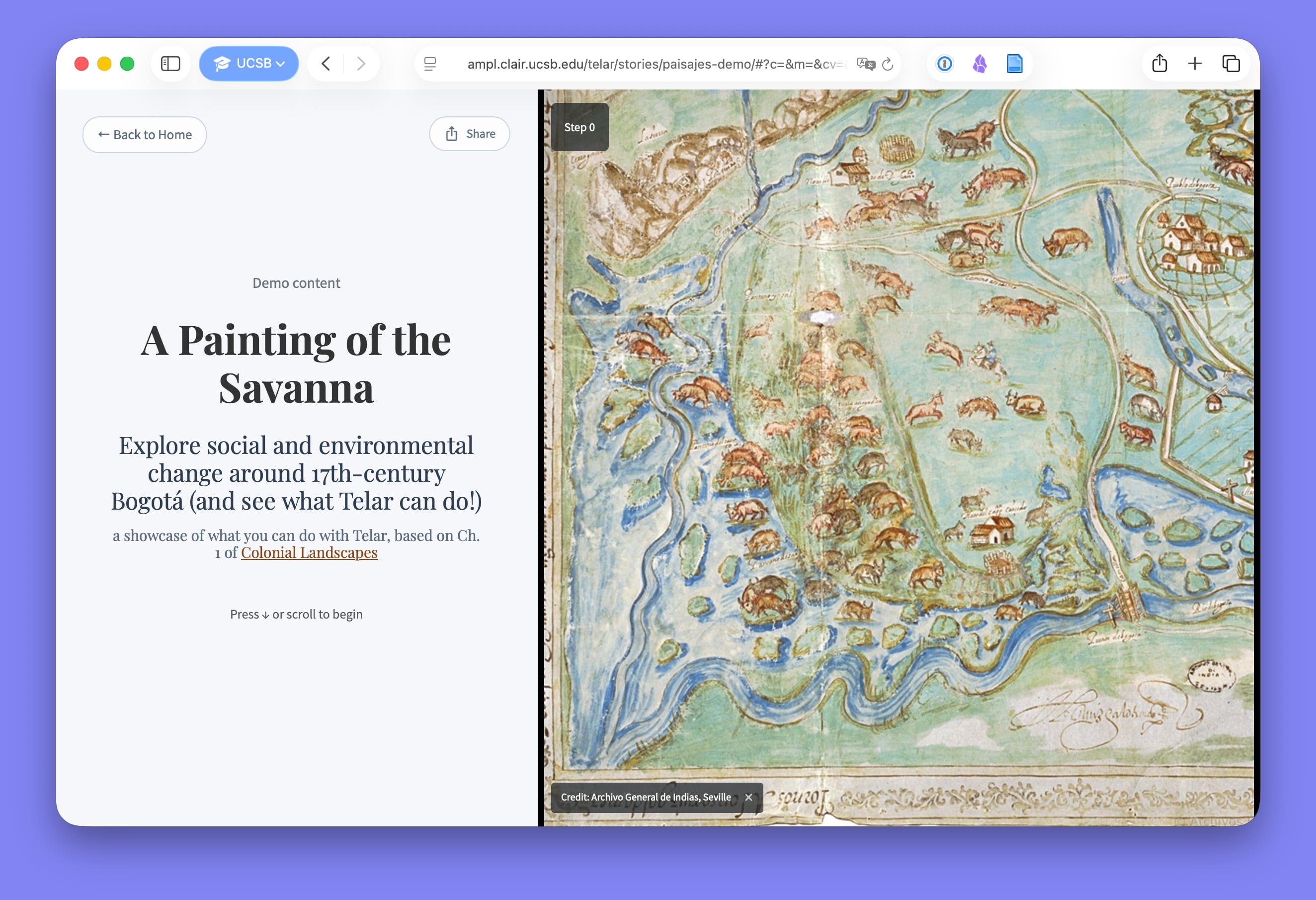
A Telar story guides readers through an image, such as a map, a manuscript, or a photograph, one detail at a time. As they scroll, the image pans and zooms to follow the story, and readers who want to go deeper can open notes, glossaries, and transcriptions along the way. Telar began with Colonial Landscapes, a bilingual website that guides Colombian school and university students through a 1614 map of the region around Bogotá. Today about 300 Telar sites are maintained by users around the world.
Current projects:
Digital storytelling with Telar. Build online exhibitions from our collections, test new features, and help us find out which ways of combining images and text work best for different audiences.
Sources for teaching. Transcribe, translate, and edit historical sources for classrooms and the public, such as a 1552 petition in which the Indigenous ruler of Xicalango, Mexico, described his people’s role in the Spanish invasion. This work starts with our paleography reading group and requires reading knowledge of Spanish.
A text-based game. In May 1591, Lucía, a Muisca woman from Fontibón, walked into the highest court in the New Kingdom of Granada and accused her town’s cacique, don Alonso, of poisoning her husband with a gourd of maize beer. We are planning a text-based video game built on the case file, and you can help turn it into the game’s story and choices.
No experience with coding or design is needed.
Research assistants work about 3–6 hours a week, including a weekly lab meeting, and can receive course credit; some projects require a two-quarter commitment. To apply, see this position on UCSB’s Undergraduate Research Directory.