
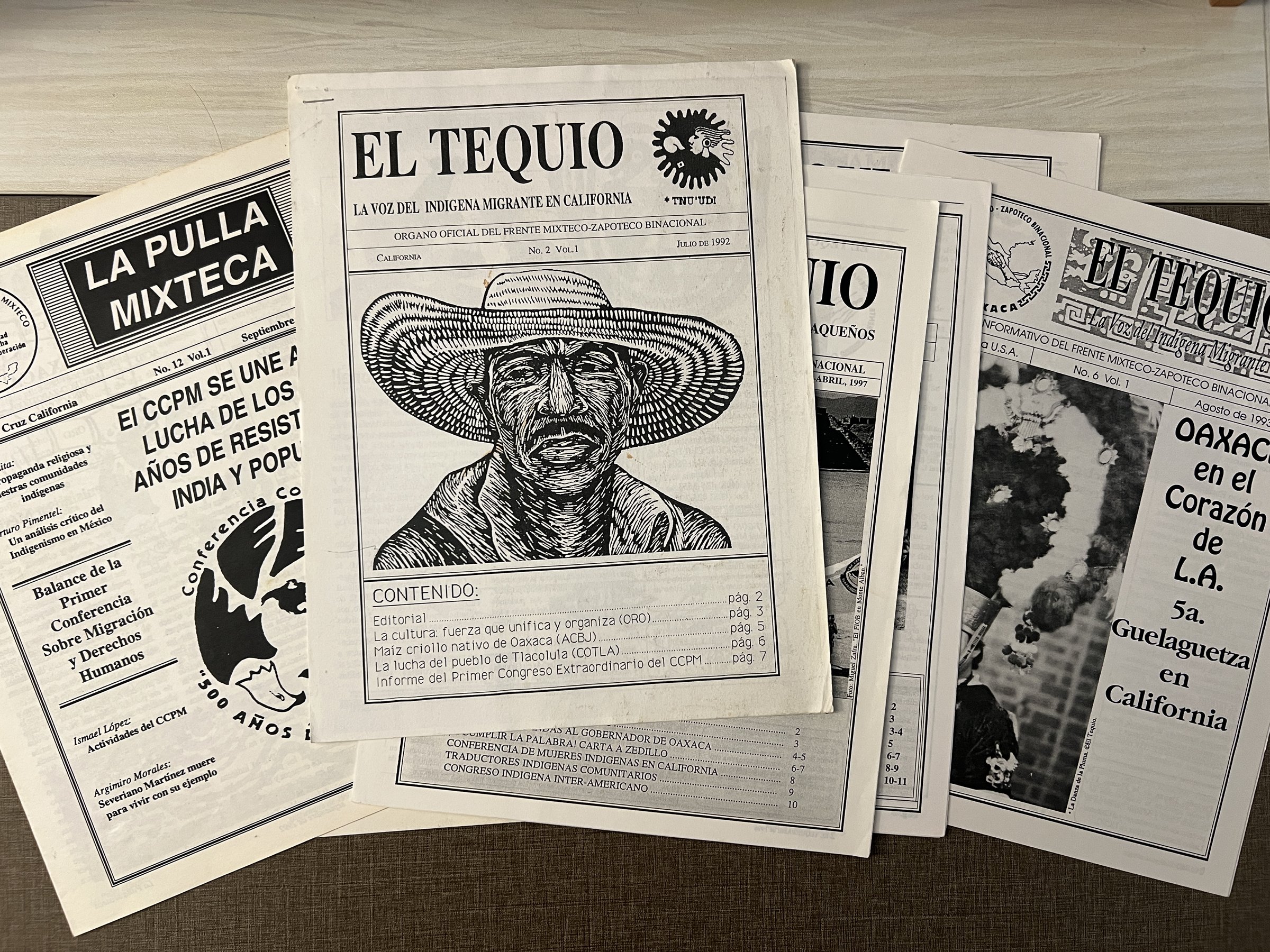
Come work at the Archives, Memory, and Preservation Lab (AMPL) of the Center for Latin American and Iberian Research!
Want to help a community preserve its own history? With Professor Jorge Ramirez-Lopez (Global Studies), we are digitizing and describing two collections that document the political organizing of Indigenous migrants from Oaxaca, Mexico. In the late 1980s and 1990s, these migrants crossed the US–Mexico border in larger numbers than before, amid an economic crisis in their home country. Many worked as farmworkers in harsh conditions, and a cohort of them organized politically as Indigenous people, both in the United States and in their communities of origin in Oaxaca. Among the most prominent organizations was the Frente Mixteco-Zapoteco Binacional (FM-ZB), founded in 1991, which became the Frente Indígena Oaxaqueño Binacional (FIOB) in 1994.
This year, two collections from this history are coming to campus:
- El Tequio, the FM-ZB and FIOB’s Spanish-language newspaper, 1991–2005. It covers the organizations’ efforts on behalf of their communities in the United States and in the Mexican states of Oaxaca and Baja California.
- The personal papers of Algimiro Morales, a founding member of a Mixteco organization connected with the FM-ZB, who began his own cultural organization in San Diego in the early 2000s. The papers run from the late 1970s and 1980s in Mexico to the late 1980s and early 2000s in San Diego.
The work has two parts, and you can take part in either or both:
Digitization. You will learn to handle these materials with care and to photograph them to archival standards, page by page, in the lab.
Description. You will catalog what we digitize in our cataloging platform, Fisqua: who produced each document, when, and what it contains. This is what lets researchers, students, and the communities themselves find and use the materials. Our team reviews your work before it enters the catalog.
This is part of Professor Ramirez-Lopez’s long-term work in collaboration with Indigenous migrant organizations and community members to preserve their histories, create popular education modules, and build ethical and reciprocal university–community partnerships. You can learn more about Professor Ramirez-Lopez’s work on his faculty page. For more on the FIOB, visit fiob.online.
Some tasks involve Spanish; others do not.
Research assistants work about 3–6 hours a week, including a weekly lab meeting, and can receive course credit; some projects require a two-quarter commitment. To apply, see this position on UCSB’s Undergraduate Research Directory.